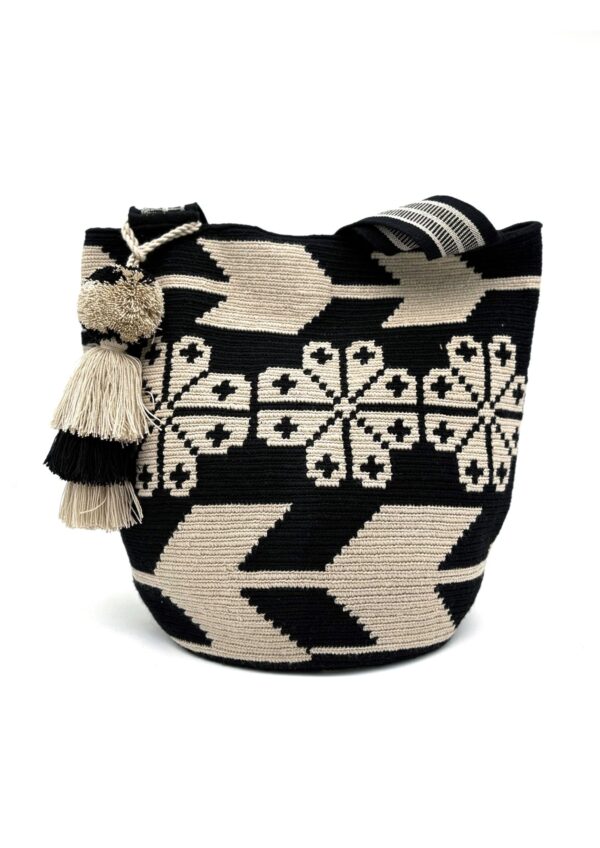
They don’t draw it out. They don’t plan it. The design reveals itself sometimes in a dream, sometimes in a whisper from the forest.
In the highlands of Colombia’s Sierra Nevada, three Indigenous tribes — the Kogui, Arhuaca, and Wayuu carry forward a tradition that is far more than craft. It is vision made tangible. The mochilas they weave are not simply accessories or artisan pieces; they are stories, emotions, and messages from the natural and spiritual world.
For generations, this form of weaving has been both a sacred transmission of knowledge and a quiet form of survival. In rural communities where economic opportunity is scarce and infrastructure remains limited, weaving provides more than expression it provides sustenance. Every thread spun and knotted is part of a lineage, but it is also part of a livelihood.
Each pattern comes from a place few of us are trained to access. Some emerge in silence, others while working the land or watching the moon. The women who create them do not copy old designs. Instead, they feel what the world is showing them in that moment and translate it into fiber. This is what makes each bag truly one of a kind.
“It came to me while I was watching the rain. I saw the lines in the earth, and I wove them into the thread.” — Francisca, Kogui artisan
1. Kogui: Weaving the Unseen
To the Kogui, weaving is a sacred extension of listening. Patterns are not chosen; they are received. Some come through meditation in the forest, others during daily work in the fields. What emerges in the mochila is often an echo of nature: rivers, mountains, cloud trails, or emotional impressions from the community.
The design in the mochila shown here represents Serankua — the First Father, the creator of all things. In Kogui cosmology, Serankua is the original source, the spirit who shaped the world through thought, silence, and balance. Each line and form in this pattern carries that weight. It’s not an abstract symbol; it’s a spiritual geometry drawn from memory, vision, and reverence.
“These aren’t decorations,” Francisca said. “They are what the mountain told me that day.”
Every Kogui bag holds this kind of moment. Their fibers, often made from fique, become a thread between worlds: the physical and the spiritual, the present and the eternal.

“This pattern represents Serankua — the First Father, the creator of all things. Each line reflects the balance he brought to the world through thought and silence.”
2. Arhuaca: Cosmic Wisdom in Wool
For the Arhuaco people, each mochila is a message passed from the cosmos. Wool is the material of choice, often left in its natural color or minimally dyed. Their designs use sacred symbols, such as rhombuses, zigzags, and triangles, to express balance, unity, and protection.
One of the most iconic symbols in Arhuaca weaving is the wavy or zigzag pattern seen in the mochila shown here. This design, while not always named in a formal sense, is referred to by some Arhuaco families as el camino de la vida — the path of life. In their native language, Iku, the deeper meaning of such patterns is often conveyed through oral tradition, as sacred teachings passed from generation to generation. These lines reflect the journey of life — full of movement, flow, and change. They also echo rivers, sacred water sources, and the energy that moves between the physical and spiritual worlds. For the Arhuaco, this pattern is a visual mantra: a reminder that balance is not a fixed point, but a rhythm we learn to follow.
The designs are not just taught; they are remembered. Grandmothers show granddaughters the meaning of the earth’s four corners, the sun and moon, the spirit of the Sierra itself. One Arhuaca woman shared that her pattern came after dreaming of two jaguars circling a tree. The next day, she began to weave.
These bags carry the language of dreams and ancestral vision. No two are ever the same because no two days, no two emotions, no two prayers are the same.

“This wavy line, called kanásü, symbolizes the river of life and the invisible paths of ancestral spirits guiding each generation.”
3. Wayuu: Stories Told in Color
The Wayuu are known for their vibrant colors and bold geometry. Each mochila is a canvas of personal expression, family history, and emotional honesty. Unlike the more muted tones of the Kogui and Arhuaca, the Wayuu embrace color as a living language.
The design in the mochila shown here features a traditional kanaasü — a sacred pattern passed down from one generation to the next in Wayuu culture. These geometric forms are far more than decoration. Some resemble süchii, symbolizing the repeating zigzag paths of life, while others mirror jime’yaa — ancestral journeys and spiritual connections that hold families and communities together.
In Wayuunaiki, the Wayuu language, such patterns are a form of storytelling. Each design carries intention, identity, and memory. The colors in this particular mochila — turquoise, pink, earthy brown, and black — are just as meaningful: water and clarity, love and feminine energy, tradition and grounding, and the presence of ancestral strength.
A young Wayuu mother once told us,
“I chose yellow because that was the week my son was born. I wove the joy into every circle.”
For them, patterns may reflect moods, milestones, or even challenges overcome. Some bags are designed as gifts, others as symbols of resilience.
Their weaving is a declaration of identity: proud, bright, enduring.

“Wayuu women pass on their weaving knowledge during a sacred rite of passage known as ‘el encierro.’ This bag was made by a mother and daughter working side by side.”
4. When You Carry One, You Carry a Vision
To outsiders, a mochila may look like a beautiful handmade bag. But to those who live in the Sierra Nevada, it is a woven prayer. Every thread holds intention. Every symbol holds meaning. Every bag is the result of a woman feeling, receiving, and responding to something far greater than herself.
To carry a mochila is not just to carry a bag — it is to carry the legacy of a people who weave in harmony with land, sky, and story. And when you choose to carry one made in true collaboration, with honesty and love, you become part of that story too.
Let’s keep these stories sacred. Let’s walk forward with purpose.
“In our world, nothing is made without meaning.” – Woven Wildly
We share this story as Woven Wildly — a living collaboration with Indigenous communities of the Sierra Nevada de Santa Marta. We don’t just sell mochilas. We carry culture.
Thank you for reading, for caring, and for helping preserve what matters.

This is what it’s really about — not just what we carry, but who we carry it for. Every mochila sold helps keep these communities strong, self-sustaining, and seen.