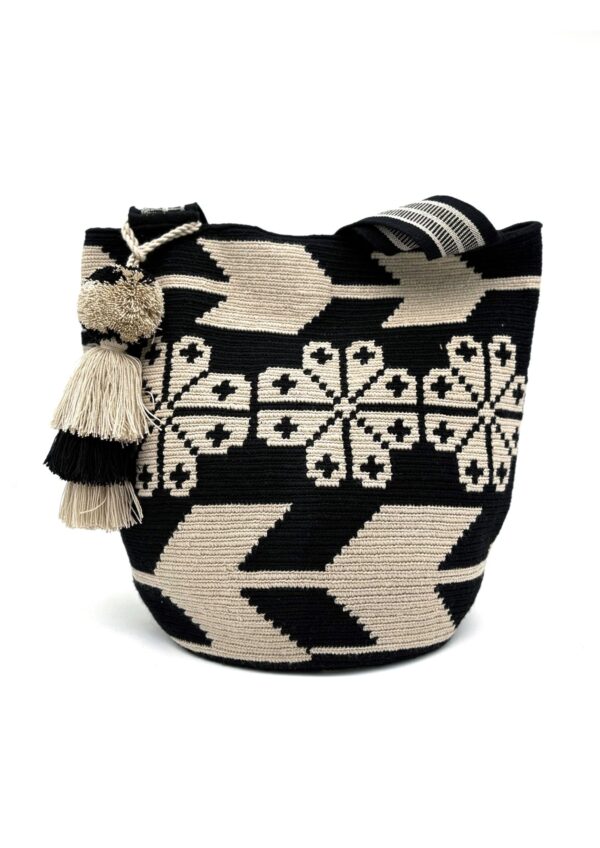
In the blistering sun of Colombia’s La Guajira desert, color is survival, weaving is resistance, and every Wayuu bag tells a story louder than words.
The sun had barely risen, but the heat was already climbing.
A Wayuu woman sat cross-legged beneath a cactus tree, her fingers dancing across a bundle of threads. A child chased goats between stones. The wind moved dry air and silence. In the stillness, the desert spoke.
This is La Guajira — unforgiving, radiant, sacred.
This is the home of the Wayuu.
And the mochila, the bag we think we know, is only the visible thread in a story thousands of years deep.
1. A Desert People, Not Defined by Despair
The Wayuu are not poor.
They are not victims.
They are not a people lost in the dust.
They are rich in story, fierce in survival, and matriarchal in power.
In Wayuu society, women lead.
Mothers are called mamas — not just by their children, but by the community.
They are decision-makers, land stewards, wisdom keepers, and economic anchors.
It is the women who manage households, guard traditions, and teach the next generation how to weave, speak, survive.
2. Weaving is Matriarchy. Weaving is Memory.
For the Wayuu, weaving is not craft — it is ceremony.
When a girl becomes a woman, she enters “el encierro” — a sacred rite of isolation guided by the women of her clan. For months, sometimes more than a year, she is taught how to cook, heal, pray, and most importantly: weave.
“The bag she creates during this time is not for sale. It is a rite of passage — as sacred as blood, as permanent as lineage.”
Wayuu women don’t invent patterns — they remember them.
Each stitch is a thread passed down from great-grandmothers to granddaughters.
3. When the Land Stopped Giving, They Adapted
Life in La Guajira has never been easy. But over the last 50 years, it’s become even harder.
Once, the Wayuu wove their mochilas with hand-grown cotton and native plant fibers. But as rainfall vanished and droughts grew longer, their crops failed. The desert, already severe, became nearly unlivable.
To survive, they turned to acrylic fibers — more affordable, more available, and more durable in a harsh environment.
These weren’t just substitutions.
They were acts of resistance — ways to continue creating when the land no longer gave what it once had.
That’s why most Wayuu mochilas today are acrylic: not a loss of culture, but a testament to its endurance.
4. A Language of Color and Code
Each Wayuu mochila is a conversation — between the weaver and her ancestors, the desert and the stars.
The patterns are called “kanaas” — geometric designs that hold sacred meanings.
A diamond may speak of womanhood and strength.
A spiral may reflect the journey of spirit and thought.
A burst of vibrant color? That’s joy after hardship, survival turned into light.
Wayuu bags are not just bright.
They are blinding with meaning — spiritual blueprints hidden in plain sight.
5. What They Carry vs What We See
To us, it might look like a beach tote.
To her, it is a map of memory, a story of water fetched on foot, of sons raised through sandstorms, of daughters becoming mothers.
“She didn’t weave it for fashion.
She wove it to feed her family.
To keep tradition alive.
To turn silence into beauty.”
We cannot afford to romanticize these bags without respecting what they cost to make.
6. A History That Refused to Fade
The Spanish never fully conquered the Wayuu — not by sword, not by scripture.
They resisted with strategy, migration, and the fierce protection of their language and land.
Today, despite being overlooked by national politics, often forgotten by aid systems, and exploited by global fashion, the Wayuu still weave, lead, and teach.
Their resilience isn’t loud.
It is spun — one thread at a time, one daughter at a time, one memory at a time.
7. Not Fast Fashion — Fast Survival
The world loves the aesthetic of the Wayuu mochila.
But it rarely honors the woman behind it.
Wayuu bags are often copied, mass-produced, or sold by middlemen who pay pennies and charge hundreds. Designs are taken. Credit is erased. And the name “Wayuu” is left off the label.
To buy a mochila without knowing the hands behind it is to profit from erasure.
These aren’t trends.
They’re economic lifelines in a region where clean water is scarce and infrastructure nearly nonexistent.
8. From the Desert to the World
When you carry a Wayuu bag, you carry La Guajira —
Wind-chafed sand. Goat tracks. Firelight. Silence.
You carry a woman’s isolation and her emergence.
You carry a grandmother’s vision, a tribe’s history, and the strength of a desert that teaches resilience daily.
“Thread by thread, they endure.
Pattern by pattern, they resist.
Color by color, they remain.”
9. We Don’t Wear Wayuu. We Walk Beside Them.
At Woven Wildly, we don’t just sell Wayuu bags.
We walk beside the women and communities who make them.
We listen. We protect their pricing. We honor their labor.
And we tell their stories with the respect they deserve.
Because no one weaves like a Wayuu woman.
And no one should profit from her truth without protecting it.
“You can buy a bag anywhere.
But you can’t buy this story without first choosing to carry it with care.
Choose the bag.
Choose the maker.
Choose the memory that lives in every thread.”
We share this story as Woven Wildly — a living collaboration with Indigenous communities of the Sierra Nevada de Santa Marta. We don’t just sell mochilas. We carry culture.
Thank you for reading, for caring, and for helping preserve what matters.

This is what it’s really about — not just what we carry, but who we carry it for.
Every mochila sold helps keep these communities strong, self-sustaining, and seen.